The Demo Worked. The Product Didn’t: Why Vibe-Coded Apps Fail in Production
The hidden production failures that break fast-built apps after launch: auth, security, billing, observability, QA, and deploy safety.
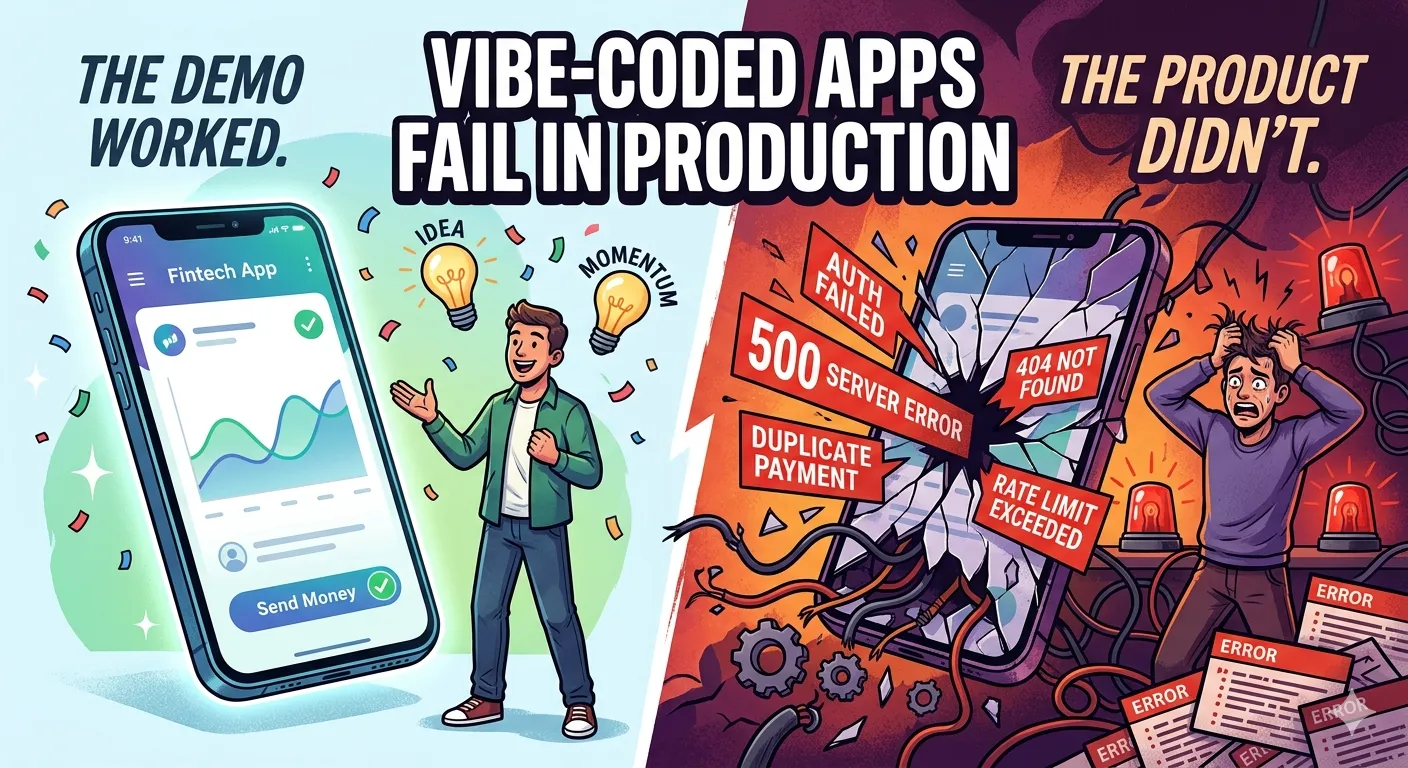
Vibe coding is good at one thing: generating momentum.
You can go from blank screen to working prototype absurdly fast. That part is real. It is not hype. It is not fake. It is also not the same thing as building a product that can survive real users.
That is the trap.
A lot of vibe-coded apps do not fail because the idea was bad. They fail because the team mistakes a working demo for a launch-ready system. The app worked on localhost. It worked in the happy path. It worked in the one polished flow shown to friends, investors, or early users.
Then reality shows up with bad inputs, retries, expired sessions, concurrent requests, broken webhooks, partial outages, weird account states, and users clicking the exact thing nobody thought to test.
Now the product is not a product. It is an incident generator.
The real gap is not code generation. It is operational reality.
A demo only needs to work once.
A real product needs to keep working when people do unpredictable things, when external services fail, when requests arrive out of order, and when someone other than the builder has to debug the mess at 2am.
That is the difference most people underestimate.
AI can generate code faster than most founders can reason about the system they are building. That creates an ownership gap. The code exists, but the understanding does not. Everything feels fine until the app leaves the clean sandbox of development and enters production, where every hidden assumption gets punched in the throat.
Where vibe-coded apps usually fail
The failure patterns are boringly consistent.
Auth and authorization
This is one of the fastest ways to turn a promising build into a liability.
Common problems:
- Missing ownership checks.
- Weak or inconsistent token validation.
- Session logic that works in tests but fails under real conditions.
- Admin routes or internal actions exposed too broadly.
- Role checks scattered across the codebase like confetti.
Authentication answers “who are you?” Authorization answers “what are you allowed to touch?”
A shocking number of fast-built apps get the first part halfway working and barely think about the second. That is how one user ends up seeing another user’s data, or how internal tools become public by accident.
If your auth logic is brittle, every other feature is sitting on a rotten floor.
Secrets and security
AI does not naturally care about security boundaries. It cares about producing plausible code that satisfies the prompt.
That means you regularly see:
- API keys hardcoded in frontend code or repo history.
- Missing input validation.
- Missing rate limits.
- Unsafe defaults.
- Over-permissioned services.
- Sensitive logs leaking more than they should.
Then people act surprised when somebody scrapes the database, abuses an endpoint, or finds a path the team never locked down.
Security work feels invisible right up until it becomes the only thing that matters.
Payments and billing
Payments are where sloppy systems stop being cute.
A bug in your onboarding flow is annoying. A bug in your billing logic damages trust.
The usual problems:
- Webhooks arriving twice and getting processed twice.
- Retries without idempotency.
- Subscription state drifting away from actual payment state.
- Refund paths barely implemented or never tested.
- Entitlements not matching what the customer actually paid for.
If your payment flow cannot survive retries, delays, and weird edge cases, you do not have a revenue system. You have a future support backlog.
Observability and debugging
A lot of vibe-coded products are impossible to operate because nobody built the systems needed to understand failure.
Typical symptoms:
- No structured logs.
- No request tracing.
- Weak monitoring.
- No useful alerts.
- Error messages that explain nothing.
- Debugging that depends entirely on the original builder remembering what they meant two weeks ago.
If a failure takes hours to diagnose, the product is underbuilt. Simple as that.
You do not own a system you cannot debug quickly.
QA and edge cases
“Works on localhost” is not QA. It is a warm-up.
Most launch failures come from the boring paths that nobody wanted to test:
- Expired sessions.
- Empty states.
- Broken retries.
- Partial third-party outages.
- Duplicated requests.
- Race conditions.
- Invalid inputs.
- User flows that cross multiple systems.
Fast builds often get tested only on the happy path. That is how teams convince themselves they are close to launch while the actual product is held together with hope and screenshots.
Data integrity and deploy safety
Some mistakes do not disappear when you redeploy. They stay in your database and keep ruining your week.
Common issues:
- Unsafe migrations.
- Schema changes with no rollback plan.
- Weak integrity checks.
- Production fixes applied manually with no clear audit trail.
- Deploy processes that assume nothing will go wrong.
This is where “ship fast” mutates into “ship and pray.”
And prayer is not a deployment strategy.
Why this keeps happening
Because speed is visible and hardening is not.
Founders can see features. They can demo flows. They can watch code appear. That feels like momentum.
But hardening work is mostly invisible:
- Tightening auth boundaries.
- Cleaning up permission logic.
- Adding rate limits.
- Testing retries.
- Instrumenting logs.
- Building rollback-safe deploys.
- Validating failure paths.
None of that looks sexy in a screenshot. None of it gets applause in a launch teaser. But it is the work that separates a real product from a polished liability.
The deeper problem is that AI accelerates code generation faster than it accelerates judgment. You can create a lot of surface area before you have earned the right to trust the system.
That is the ownership gap.
What hardening actually means
Hardening is not adding enterprise nonsense. It is reducing the number of stupid ways the product can fail.
In practice, that means:
- Explicit authentication and authorization boundaries.
- Secure secret handling.
- Input validation and rate limiting.
- Idempotent billing flows.
- Structured logs, traces, and alerts.
- Regression coverage on critical paths.
- Safe deploy and rollback procedures.
- Clear operational ownership for the ugly parts nobody wants to own.
The goal is not perfection.
The goal is that real users can touch the system without turning your week into a fire.
A practical pre-launch hardening checklist
Before you launch, ask blunt questions:
- Can one user access another user’s data?
- Do tokens, sessions, and auth failures fail safely?
- Are secrets exposed anywhere they should not be?
- Can payment events retry without corrupting account state?
- Can you explain and debug the top five likely failures quickly?
- Do you have logs and alerts that would actually help during an incident?
- Can you roll back a bad deploy without improvising?
- Have the critical user flows been tested end to end?
If the answer to several of these is “not really,” then you do not need more features. You need hardening.
Vibe coding is not the enemy
Vibe coding is useful. It is fast. It is a real advantage when used properly.
The mistake is pretending speed removes the need for engineering discipline.
It does not.
It just lets you arrive at the dangerous part faster.
The demo getting built is not the finish line. It is the start of the part that determines whether the thing deserves real users.
If you already built the product but do not fully trust it in production, that is not a branding problem. That is not a “post more on X” problem. That is a last-mile product problem.
And last-mile product problems are exactly where products live or die.
If that is where you are stuck, that is the gap ShipLaunch is built to close.